Πέμπτη 14 Απριλίου 2022

Augmentation of the width and thickness of keratinised gingiva using a collagen biomaterial in apically positioned flap surgery: A technical note

alwin shared this article with you from Inoreader
To ensure that dental implants remain functional in the long-term, adequate thickness and width of keratinised tissue at the cervical collars are essential.1 Once a tooth is lost, the height of the alveolar bone is reduced, and the keratinised tissue of the edentulous area recedes.2 There are two techniques currently used to obtain the desired keratinised tissue augmentation: the apically positioned flap surgery and the free gingival graft surgery.2 The apically positioned flap surgery, the existing keratinised tissue is incised at the mucosal or mucoperiosteal flap to enable natural extension of the incised end. (Source: The British Journal of Oral and Maxillofacial Surgery)
View on the web

SEARCH FOR EXPERIMENTAL EVIDENCE OF DOSE-RATE AND WALL SCATTERING EFFECTS IN THE THERMOLUMINESCENCE RESPONSE OF LIF:MG,TI (TLD-100)

alwin shared this article with you from Inoreader
Abstract
An experimental investigation into the possibility of dose-rate effects and wall scatter in the thermoluminescent response of LiF:Mg,Ti (TLD-100) was carried out. The investigation was motivated by theoretical simulations predicting the possible presence of dose-rate effects coupled with the lack of detailed experimental studies. The dose rate was varied by changing the source to sample distance, by the use of attenuators, sources of 137Cs of various activities, filtration and the construction of identical geometrical irradiators of Teflon and stainless steel. Four levels of dose in the linear dose response region were studied at 10−2 Gy, 1.5 × 10⁻² Gy, 0.1 Gy and 0.5 Gy to avoid complications in interpretation due to supralinearity above 1 Gy. At the dose of 1.5 × 10⁻² Gy, the dose rate was varied by five orders of magnitude from 4.9 × 10⁻³ Gy s−1 to 4.9 × 10− 8 Gy s−1. At the other levels of dose, a one to two orders of magnitude in dose rate was achieved. Within the measurement uncertainty of 5–10%, no dose-rate effects were observed in any of the experimental measurements and no changes in the shape of the glow curve were observed. The maximum wall scatter effect (Teflon to stainless steel) was measured at ~8% within the experimental uncertainty and well below expectations. The results are encouraging with respect to the accurate and reproducible use of LiF:Mg,Ti under various experimental conditions of irradiation.
View on the web

Τρίτη 12 Απριλίου 2022

Status of IDH mutations in chondrosarcoma of the jaws

alwin shared this article with you from Inoreader
The aim was to analyse the relationship between mutations of the isocitrate dehydrogenase gene (IDH) and clinical characteristics of chondrosarcoma of the jaw in order to provide new information on its molecular pathology. Tissue samples were collected from 25 patients diagnosed with chondrosarcoma of the jaw. IDH mutations were detected through polymerase chain reaction and direct sequencing. Clinicopathological data were analysed retrospectively. The study included 14 female and 11 male patients; the median patient age was 38 years. (Source: International Journal of Oral and Maxillofacial Surgery)
View on the web

Percutaneous Pulmonary Angioplasty for Patients With Takayasu Arteritis and Pulmonary Hypertension

alwin shared this article with you from Inoreader

1-s2.0-S073510972200434X-fx1.jpg

Publication date: 19 April 2022

Source: Journal of the American College of Cardiology, Volume 79, Issue 15

Author(s): Yu-Ping Zhou, Yun-Peng Wei, Yin-Jian Yang, Xi-Qi Xu, Tao Wu, Chao Liu, Ke-Yi Mei, Fu-Hua Peng, Hai-Ping Wang, Kai Sun, Jing-Yi Li, Hui-Fang Wang, Meng-Tao Li, Duo-Lao Wang, Qi Miao, Xin Jiang, Zhi-Cheng Jing

View on the web

Poor Treatment Outcomes with Second-Line Chemotherapy in Advanced Synovial Sarcoma

alwin shared this article with you from Inoreader
Via Oncology
CONCLUSION: Our exploratory study revealed that the response rate of second-line chemotherapy regimens for patients with synovial sarcoma was 9.4%. Therefore, there is an urgent need to develop more active therapeutic regimens for synovial sarcomas.PMID:35405680 | DOI:10.1159/000524500 (Source: Oncology)
View on the web

Retrospective analysis of adjuvant radiotherapy in oral cavity or oropharyngeal cancer: Feasibility of omitting lower-neck irradiation

als.fakia shared this article with you from Inoreader

journal.pone.0266678.g002&size=inline

by Sheng-Yow Ho, Wan-Chen Kao, Sheng-Yen Hsiao, Sheng-Fu Chiu, Sung-Wei Lee, Jia-Chun Chen, Li-Tsun Shieh

Objectives

Adjuvant radiotherapy is the standard of care in locally advanced head and neck cancers. The radiation field is correlated with the surgical field in the adjuvant radiotherapy setting; therefore, tailoring the irradiation field is reasonable.

Materials and methods

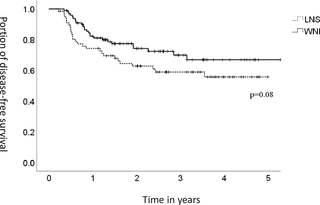
We retrospectively analyzed patients with oral cavity and oropharyngeal cancers included in the cancer registry between 2015 and 2019 in the study hospital. Patients who underwent whole-neck irradiation (WNI) were compared with those who underwent lower-neck–sparing (LNS) irradiation.

Results

A total of 167 patients with oral cavity and oropharyngeal cancers were included in the study. Cancer recurrence was recorded in 33% of the patients. The rate of recurrence of oral cavity and oropharyngeal cancer at neck level IV was 8%. The 2-year incidence of level IV recurrence was lower in the WNI group than in the LNS group (2% vs. 10%; p = 0.04). The 2-year disease-free survival rates were 75% and 63% in the WNI and LNS groups, respectively (p = 0.08).

Conclusion

The rate of level IV recurrence was higher in the LNS group than in the WNI group. Trends of improvement in disease-free survival with lower-neck irradiation suggested that it is premature to consider LNS irradiation as daily practice in patients with oral cavity and oropharyngeal cancer.


View on the web

Κυριακή 10 Απριλίου 2022

Estimation of Relative Vaccine Effectiveness in Influenza: A Systematic Review of Methodology

alexandrossfakianakis shared this article with you from Inoreader
imageBackground: When new vaccine components or platforms are developed, they will typically need to demonstrate noninferiority or superiority over existing products, resulting in the assessment of relative vaccine effectiveness (rVE). This review aims to identify how rVE evaluation is being performed in studies of influenza to inform a more standardized approach. Methods: We conducted a systematic search on PubMed, Google Scholar, and Web of Science for studies reporting rVE comparing vaccine components, dose, or vaccination schedules. We screened titles, abstracts, full texts, and references to identify relevant articles. We extracted information on the study design, relative comparison made, and the definition and statistical approach used to estimate rVE in each study. Results: We identified 63 articles assessing rVE in influenza virus. Studies compared multiple vaccine components (n = 38), two or more doses of the same vaccine (n = 17), or vaccination timing or history (n = 9). One study compared a range of vaccine components and doses. Nearly two-thirds of all studies controlled for age, and nearly half for comorbidities, region, and sex. Assessment of 12 studies presenting both absolute and relative effect estimates suggested proportionality in the effects, resulting in implications for the interpretation of rVE effects. Conclusions: Approaches to rVE evaluation in practice is highly varied, with improvements in reporting required in many cases. Extensive consideration of methodologic issues relating to rVE is needed, including the stability of estimates and the impact of confounding structure on the validity of rVE estimates.
View on the web