Κυριακή 15 Νοεμβρίου 2020

Clinical Challenges in the Management of Hormone Receptor-Positive, Human Epidermal Growth Factor Receptor 2-Negative Metastatic Breast Cancer: A Literature Review

Alexandros G.Sfakianakis shared this article with you from Inoreader

12325.jpg

Abstract

Endocrine therapy (ET) is integral to the treatment of hormone receptor-positive (HR+), human epidermal growth factor receptor 2-negative (HER2−) metastatic breast cancer (MBC). Aromatase inhibitors (AIs; e.g., anastrozole, letrozole, exemestane), selective estrogen receptor modulators (e.g., tamoxifen), and the selective estrogen receptor degrader, fulvestrant, inhibit tumor cell proliferation by targeting ER signaling. However, the efficacy of ET could be limited by intrinsic and acquired resistance mechanisms, which has prompted the development of targeted agents and combination strategies. In recent years, the treatment landscape for HR+, HER2− MBC has evolved rapidly. AIs, historically the first-line treatment for postmenopausal patients with HR+, HER2− MBC, have been challenged by more effective ET, such as fulvestrant alone or in combination with an AI, and the cyclin-dependent kinase (CDK)4/6 inhibitors, which have increasingly become the new standa rd of care. For endocrine-resistant disease (≥ second-line), clinical trials demonstrated that the mammalian target of rapamycin inhibitor, everolimus, enhanced the efficacy of exemestane or fulvestrant after progression on an AI. CDK4/6 inhibitors in combination with fulvestrant have demonstrated superior progression-free survival and overall survival versus fulvestrant alone. Recently, the combination of fulvestrant with alpelisib in phosphatidylinositol-4,5-bisphosphate 3-kinase (PIK3CA) mutated HR+, HER2− MBC following progression on or after ET was approved, based on the SOLAR-1 study. However, the optimal sequencing of treatments is unknown, especially following disease progression on a CDK4/6 inhibitor. This review aims to provide practical guidance for the management of HR+, HER2− MBC based on available data and the utility of genomic biomarkers, including germline breast cancer genes 1 and 2 (BRCA1/2) mutations, and somatic estrogen receptor alpha gene (ESR1), HER2, and PIK3CA mutations.


View on the web

Ethosuximide Induced Macroglossia and Oropharyngeal Edema

Alexandros G.Sfakianakis shared this article with you from Inoreader

1-s2.0-S0165587620X00097-cov150h.gif

Publication date: Available online 15 November 2020

Source: International Journal of Pediatric Otorhinolaryngology

Author(s): Hanqing Shang, Mica Glaun, Julina Ongkasuwan

View on the web

JPM, Vol. 10, Pages 231: Ocular Vascular Changes in Mild Alzheimer’s Disease Patients: Foveal Avascular Zone, Choroidal Thickness, and ONH Hemoglobin Analysis

Alexandros G.Sfakianakis shared this article with you from Inoreader

JPM, Vol. 10, Pages 231: Ocular Vascular Changes in Mild Alzheimer's Disease Patients: Foveal Avascular Zone, Choroidal Thickness, and ONH Hemoglobin Analysis

Journal of Personalized Medicine doi: 10.3390/jpm10040231

Authors: Elena Salobrar-Garcia Carmen Méndez-Hernández Rosa de Hoz Ana I. Ramírez Inés López-Cuenca José A. Fernández-Albarral Pilar Rojas Surina Wang Julián García-Feijoo Pedro Gil Juan J. Salazar José M. Ramírez

In Alzheimer’s disease (AD), vascular changes could be caused by amyloid beta (Aβ) aggregates replacing the contractile smooth musculature of the arteriole walls. These changes happen in the brain vascular network, but also in the eye, and are related to decreased vascular density and low blood flow. In patients with Alzheimer’s disease, thinning of the choroid and the retina has been shown. The aim of this prospective study was to assess the retinal and choroidal vascular systems, analyzing the choroidal thickness with optical coherence tomography (OCT), the foveal avascular zone (FAZ) with OCT-angiography (OCTA), and the optic nerve head (ONH) hemoglobin with the Laguna ONhE program, to evaluate which of the two ocular vascular systems shows earlier changes in mild AD patients. These patients, compared to controls, showed a significantly thinner choroid at all the analyzed points, with the exception of the temporal macula (at 1000 and 1500 &micr o;m from the fovea). On the other hand, the FAZ and ONH hemoglobin did not show significant differences. In conclusion, a thinner choroid was the main ocular vascular change observed in mild AD patients, while the retinal vessels were not yet affected. Therefore, choroidal thickness could be used an early biomarker in AD.

View on the web

Contralateral tension pneumothorax during video-assisted thoracic surgery for lung cancer in a patient with obesity and rib fractures: a case report and review of the literature

Alexandros G.Sfakianakis shared this article with you from Inoreader

13256.jpg

Intraoperative contralateral pneumothorax during one-lung ventilation is a rare but life-threatening complication. Although the exact incidence is unknown, only 14 cases with this complication have been report...
View on the web

A Subset of Intrahepatic Cholangiocarcinomas Express Albumin RNA as Detected by In Situ Hybridization

Alexandros G.Sfakianakis shared this article with you from Inoreader
Intrahepatic cholangiocarcinomas (ICCs) show morphologic diversity, ranging from tumors composed of nonmucinous small ducts to mucin-producing large duct tumors to tumors with mixed hepatocellular carcinoma features. Diagnosing ICCs can be difficult, especially on biopsy, not only because of the morphologic diversity, but also because metastatic tumors are often in the differential diagnosis. Recently, branched DNA-based albumin RNA in situ hybridization (ISH) has been shown to be a potential sensitive and specific marker for ICC with 99% sensitivity. Using a different RNA ISH technology, we evaluated the expression of albumin RNA ISH in ICC. We performed RNA ISH for albumin using RNAscope on 43 ICCs in a triplicate tissue microarray. Albumin RNA ISH was positive in 18 of 43 (42%) I CCs. Five of the 6 (83%) combined hepatocellular carcinoma-CC were positive in the CC component. None of the tumors with mucin production were positive (0/9). In our cohort, albumin RNA ISH showed a sensitivity of 42% in ICCs, supporting the morphologic diversity of ICCs. Albumin RNA ISH does not appear to be a highly sensitive marker for ICC and hence cannot be used as a stand-alone marker for ICC. The authors declare no conflict of interest. Reprints: Vaidehi Avadhani, MD, Emory University Hospital/Grady Memorial, 80 Jesse Hill Jr. Drive SE, Atlanta, GA 30303 (e-mails: vavadha@emory.edu; vpathology@gmail.com). Received April 22, 2020 Accepted October 7, 2020 Copyright 2020 Wolters Kluwer Health, Inc. All rights reserved.
View on the web

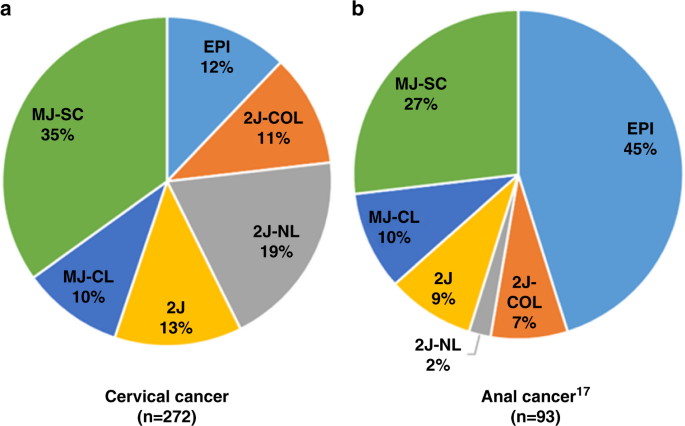
Human papilloma virus (HPV) integration signature in Cervical Cancer: identification of MACROD2 gene as HPV hot spot integration site

Alexandros G.Sfakianakis shared this article with you from Inoreader

41416_2020_1153_Fig1_HTML.png

British Journal of Cancer, Published online: 16 November 2020; doi:10.1038/s41416-020-01153-4

Human papilloma virus (HPV) integration signature in Cervical Cancer: identification of MACROD2 gene as H PV hot spot integration site
View on the web

Cancers, Vol. 12, Pages 3382: Comprehensive Gene Mutation Profiling of Circulating Tumor DNA in Ovarian Cancer: Its Pathological and Prognostic Impact

Alexandros G.Sfakianakis shared this article with you from Inoreader
Μέσω Cancers

cancers-12-03382-ag-550.jpg

Cancers, Vol. 12, Pages 3382: Comprehensive Gene Mutation Profiling of Circulating Tumor DNA in Ovarian Cancer: Its Pathological and Prognostic Impact

Cancers doi: 10.3390/cancers12113382

Authors: Tomoko Noguchi Naoyuki Iwahashi Kazuko Sakai Kaho Matsuda Hitomi Matsukawa Saori Toujima Kazuto Nishio Kazuhiko Ino

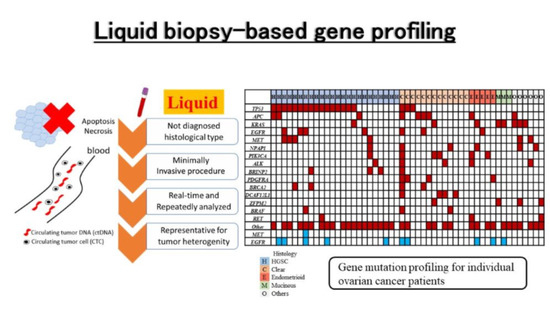
Liquid biopsies from circulating tumor DNA (ctDNA) have been employed recently as a non-invasive diagnostic tool for detecting cancer-specific gene mutations. Here, we show the comprehensive gene mutation profiles of ctDNA in 51 patients with different histological subtypes of stage I–IV ovarian cancer, and their association with clinical outcomes. The ctDNA extracted from pre-treatment patients’ plasma were analyzed using Cancer Personalized Profiling by Deep Sequencing targeting 197 genes. Of 51 patients, 48 (94%) showed one or more non-synonymous somatic mutations, including TP53 (37.3%), APC (17.6%), KRAS (15.7%), EGFR (13.7%), MET (11.8%), PIK3CA (11.8%), NPAP1 (11.8%), and ALK (9.8%). The most frequently mutated genes were as follows: TP53 in high-grade serous carcinoma (66.7%), APC in clear cell carcinoma (30.8%), PIK3CA in endometrioid carcinoma (40%), and KRAS in mucinous carcinoma (66.7%). Higher cell-free (cf)DNA concentration significantly correlat ed with worse progression-free survival (PFS) in all patients as well as stage III–IV patients (p = 0.01 and 0.005, respectively). Further, patients with any pathogenic mutations showed significantly worse PFS (p = 0.048). Blood tumor mutational burden detected from ctDNA did not significantly correlate with the histological subtypes or survival. Collectively, clinico-genomic profiles of individual ovarian cancer patients could be identified using ctDNA and may serve as a useful prognostic indicator. These findings suggest that ctDNA-based gene profiling might help in establishing personalized therapeutic strategies.

View on the web